

This article is analysis ,AMD Stock Price Prediction 2030 not investment advice. I am not a financial advisor. Every figure below is sourced; every projection is a clearly-labeled scenario, not a forecast.
Advanced Micro Devices closed at $559.82 on Friday, September 18, 2026, giving it a market capitalization near $914 billion. Four years earlier, the same company was a distant second in server CPUs with no meaningful AI accelerator business. The gap between those two realities is the entire investment question.
Where Does AMD Stand as of September 2026?
Short answer: AMD is mid-transition from a chip component vendor into a rack-scale AI infrastructure supplier, with data center now the majority of revenue and a valuation that already assumes the transition works.
The Q2 FY2026 results, reported August 4, 2026, are the clearest snapshot:
| Metric | Q2 FY2026 | Year-over-Year |
|---|---|---|
| Total revenue | $11.5B (record) | +50% |
| Data Center revenue | $6.72B | +107% |
| Data Center share of revenue | 58% | — |
| Data Center operating income | $2.10B | From a $155M loss |
| Non-GAAP gross margin | 56% | +200bps |
| Non-GAAP EPS | $1.66 | +82% (comparable basis) |
| Q3 FY2026 guidance | ~$13B ±$300M | +41% at midpoint |
Two details matter more than the headline. First, the data center segment swung from an operating loss of $155 million to $2.1 billion of operating income in twelve months — that’s operating leverage arriving, not just revenue growth. Second, gross margin expanded to 56% while accelerator mix rose, which contradicts the usual pattern where hardware systems dilute product margin.
The market’s reaction was instructive: despite beating on both revenue and EPS, shares fell roughly 9% after hours. That tells you the bar is high.
What Actually Drives AMD Between Now and 2030?

Helios and the MI450 Ramp
Helios is AMD’s first rack-scale AI platform, combining Instinct MI455X GPUs, sixth-generation EPYC “Venice” CPUs, Pensando networking, and the ROCm software stack into a turnkey system. It ships from the second half of 2026, with infrastructure coming online from Q4 2026.
This is the structural pivot. Selling a rack rather than a chip multiplies the revenue per deployment and directly attacks NVIDIA’s full-system advantage.
sourecs: https://finance.yahoo.com
The Committed Demand Pipeline
- OpenAI: a multi-year agreement announced October 5, 2025 covering up to 6 gigawatts, beginning with roughly 1GW of MI450-class hardware in H2 2026
- Meta Platforms: a separate commitment announced February 23, 2026, also up to 6 gigawatts on similar multi-generation terms
- Oracle: an initial OCI supercluster deployment of 50,000 MI450-series GPUs from calendar Q3 2026
- Microsoft: Helios deployment at scale on Azure
Combined, the Meta and OpenAI commitments alone represent roughly 12 gigawatts of contracted accelerator demand. Reporting during Q3 2026 also pointed to a further multi-gigawatt commitment from Anthropic, which would mark a frontier-model training customer rather than an inference-only one.
Management’s Own Forward Framing
On the Q2 call, AMD guided to data center segment revenue more than doubling again in 2027, with server CPU revenue growing over 70% and the data center AI business growing well over 100%. That’s the company’s number, not an analyst’s.
AMD Stock Price Prediction 2030: Three Scenarios
Short answer: using transparent revenue, margin, share-count and multiple assumptions, a reasonable 2030 range spans roughly $300 in a bear case to around $1,200 in a bull case, with a base case in the $600–650 region.
Here is the arithmetic, stated openly so you can replace any input:
| Assumption (FY2030) | Bear | Base | Bull |
|---|---|---|---|
| Total revenue | $95B | $150B | $220B |
| Net margin | 22% | 26% | 30% |
| Net income | $20.9B | $39.0B | $66.0B |
| Diluted shares | 1.75B | 1.85B | 1.95B |
| Implied EPS | ~$12 | ~$21 | ~$34 |
| P/E multiple | 25x | 30x | 35x |
| Implied share price | ~$300 | ~$630 | ~$1,190 |
What each case requires.
Bear (~$300): Helios timing slips, a second vendor wins share at the hyperscalers, or contracted gigawatts get pushed rather than pulled forward. Note this doesn’t require a crash — AMD traded below this level as recently as May 5, 2026. It only requires a return to where the stock sat months ago, alongside multiple compression as growth normalizes.
Base (~$630): AMD converts the first gigawatt for each anchor customer roughly on schedule, holds gross margin near 56%, and settles into a mature-growth multiple by 2030. This is roughly the trajectory management has publicly guided toward.
Bull (~$1,190): Later gigawatt tranches accelerate, ROCm achieves genuine parity in developer mindshare, and margin expands rather than compresses as rack-scale mix rises. That last condition is the hardest — selling integrated systems has historically dragged product margin down.
The Dilution Nobody Mentions
Most AMD forecasts model revenue and margin and stop there. They miss something material.
Both the OpenAI and Meta agreements include warrants for up to 160 million shares each at $0.01 — a combined 320 million potential shares, roughly 20% of the current share count. Vesting is tranched against gigawatt delivery milestones and, critically, is also subject to AMD share-price thresholds that escalate to $600 per share for the final tranche. The OpenAI warrant runs to October 5, 2030; the Meta warrant to February 23, 2031.
The consequence is elegant and uncomfortable at once: the bull case is partly self-limiting. The conditions that would drive the stock highest are precisely the conditions that trigger maximum dilution. A $914 billion market cap on today’s share count becomes roughly $1.42 trillion fully diluted at the same price. Any 2030 target that ignores this is overstating per-share upside.
What Do Analysts Currently Expect?
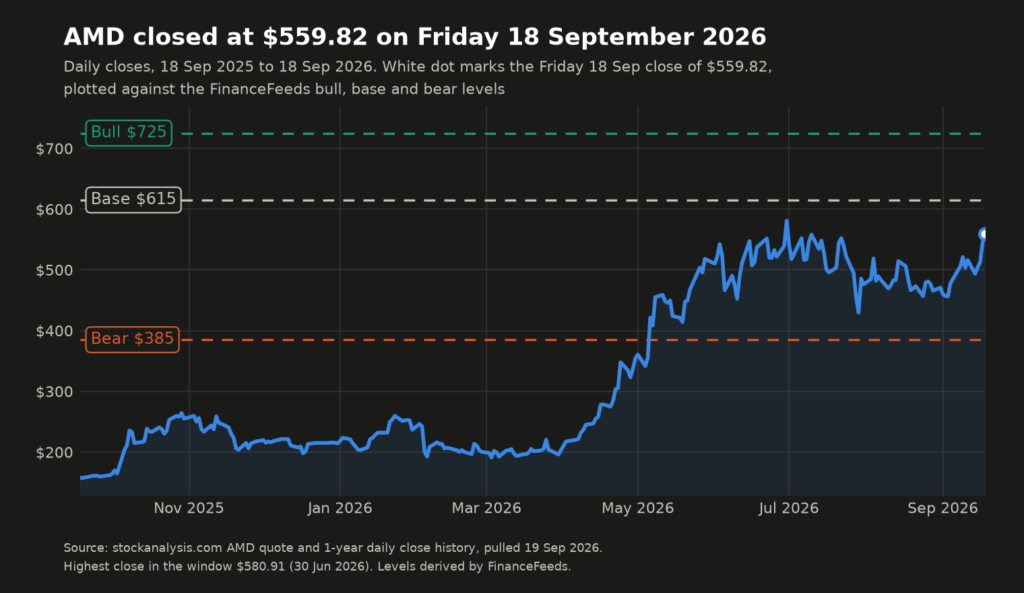
Published targets as of mid-2026 clustered in the $600–725 range, including KeyBanc at $725, UBS at $700, Rosenblatt at $655, Goldman Sachs at $640, Stifel at $635, and Raymond James lifting to $641 on an upgrade to Strong Buy. Morgan Stanley is the notable dissenter, having moved to Equal Weight on the argument that the AI catch-up story is already priced in.
One honest caveat that most roundups smooth over: forward EPS estimates for FY2027 vary dramatically, from roughly $10 to above $15 depending on the source. That spread — a 50%+ disagreement about earnings just one year out — is itself the most useful data point in this article. If professionals can’t converge on 2027, treat any confident 2030 number with appropriate skepticism.
What Are the Real Risks?
- Valuation leaves no room for error. A trailing P/E near 194 prices in flawless execution.
- Execution on Helios. Yield or timing slips disclosed on an earnings call would hit hard.
- Export controls. The $800 million MI308 inventory charge in Q2 FY2025 showed exactly how this transmits to earnings. Any widening beyond MI308 is a live risk.
- Custom silicon. Hyperscalers building their own accelerators cap the merchant chip TAM regardless of how good MI450 is.
- Software. ROCm versus CUDA remains the deepest moat AMD has to cross.
- Cyclical drag. The gaming segment fell 31% year-over-year in Q2 FY2026, and higher memory costs are pressuring the PC market into H2 2026.
What Would Confirm the Bull Thesis?
Watch for these specific, checkable markers rather than sentiment:
- Two consecutive quarters of Helios revenue tracking the guided H2 2026 server growth
- MI450 shipment confirmation against the OpenAI, Meta and Oracle commitments
- Non-GAAP gross margin holding at or above 56% as AI mix rises
- Second-gigawatt tranches pulled forward rather than pushed out
Frequently Asked Questions
What is the AMD stock 2030 price prediction?
No one can predict it, but scenario analysis gives a defensible range. Using the assumptions in the table above, AMD could plausibly trade anywhere from roughly $300 in a bear case to around $1,190 in a bull case by 2030, with a base case near $630. The outcome depends primarily on whether AMD converts its committed gigawatt pipeline on schedule and holds gross margin near 56%, and on how much of the 320 million warrant share overhang vests.
What is the AMD stock price prediction for 2026?
For the remainder of 2026, the anchor is company guidance rather than speculation: Q3 FY2026 revenue of approximately $13 billion (±$300 million), up 41% year-over-year at the midpoint, with management expecting data center sales to accelerate in the second half. Published analyst targets cluster between $600 and $725, against a September 18, 2026 close of $559.82. The key near-term variable is whether Helios revenue recognition begins on schedule in Q4 2026.
What is the AMD stock price prediction for 2027?
2027 is the year the thesis gets tested. AMD has guided to data center revenue more than doubling year-over-year, server CPU revenue growing over 70%, and data center AI growing well over 100%. Analyst FY2027 EPS estimates range from roughly $10 to above $15 — an unusually wide spread that reflects genuine disagreement about the pace of the MI450 and Helios ramp rather than sloppy modeling.
Is there a reliable AMD stock price prediction for 2030 by month?
No. Month-by-month price tables for a year four years out are not analysis — they are generated numbers presented in a format that implies precision nobody has. Equity prices over multi-year horizons are driven by earnings surprises, multiple re-rating, and macro conditions that cannot be resolved to monthly granularity. Treat any site publishing a January-through-December 2030 price table as an automated content farm, not a research source.
What about an AMD stock price prediction for 2050?
A 2050 forecast for a semiconductor company is not a meaningful exercise. Twenty-four years ago, the dominant computing architectures, the leading foundry nodes, and the existence of large language models were all unknown. Semiconductors are among the fastest-moving industries in the economy, and the useful planning horizon for a company like AMD is three to five years. If you are investing on a 2050 timeframe, the relevant analysis is about diversification and position sizing, not a price target.
FAQ Schema (JSON-LD)
Important Entities Mentioned
| Entity | Type | Role in Article |
|---|---|---|
| Advanced Micro Devices (AMD) | Company, NASDAQ: AMD | Primary subject |
| Lisa Su | CEO | Company leadership |
| Jean Hu | EVP, CFO & Treasurer | Quoted on Q2 FY2026 results |
| AMD Instinct MI450 / MI455X | AI accelerator | Core growth driver |
| AMD Helios | Rack-scale AI platform | Structural pivot |
| AMD EPYC “Venice” | 6th-gen server CPU | Data center CPU line |
| ROCm / Pensando | Software / networking | Platform components |
| OpenAI | Customer | 6GW commitment, share warrant |
| Meta Platforms | Customer | 6GW commitment, share warrant |
| Oracle / Microsoft Azure | Customers | MI450 and Helios deployments |
| NVIDIA / Intel | Competitors | Competitive context |
| KeyBanc, UBS, Goldman Sachs, Morgan Stanley, Raymond James, Rosenblatt, Stifel | Research firms | Published price targets |
Suggested Featured Image Idea
A clean financial-editorial graphic: a stylized AMD share-price line rising from left to center, then splitting into three labeled forks — a steep green “Bull,” a moderate blue “Base,” and a declining amber “Bear” — each ending at a 2030 milepost. A faint semi-transparent server-rack silhouette sits behind the chart to signal the data center thesis, with a small callout box reading “320M warrant shares.” Use original vector art, no AMD logo or trademarked product imagery.
Alt text: “AMD stock price prediction 2030 chart showing bull, base and bear case scenarios branching from 2026.”
Body runs roughly 1,500 words excluding titles, schema and entity table. Want this as a Markdown or Word file?
AlsoRecl